Audio Visual Study Performance 2026 at Tama Art University
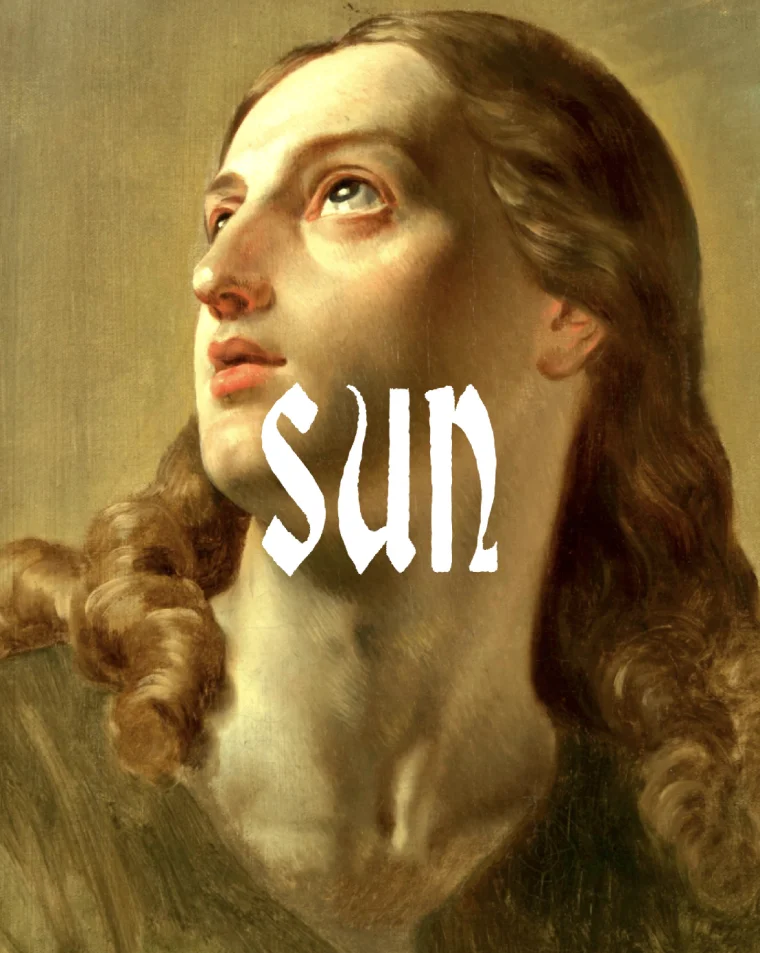
Performed once each day on August 1 and 2, 2026, at the Kaminoge Campus, Tokyo. The venue was Maglabo. An improvised sixteen-minute performance, with all visuals and music generated and controlled in real time. The program was Praeludium (three short pieces), followed by SUN. Watch the four-minute digest.
tables in Kento Season 01, objkt's Physical Art Cards
Season 01 opened on Kickstarter on September 1, 2026. Its theme is Web Nostalgia. tables is one of its two Grail cards, the rarest tier. See Kento.
Two Essays on qubibi in Automat Research, a Digital Art Lab
Published in July 2026. Both are by Giannis Sourdis: “hello world by qubibi”, which finds the work “discovered as much as designed,” and “qubibi”, on the practice as a whole.
Through Tubes, We Now Are on SuperRare
The drawing tool Through Tubes changes with every release; for SuperRare, it also became interactive. Eighteen works in all: three interactive works (Neon, Chalk and Pen), twelve stills (two people, two birds, two dogs, six tubes), and three stop-motion videos shot from frames printed on paper. Released on May 11, 2026, curated by SuperRare. Collect here Sold out. See more images.
hello world at Tama Art University
Held March 31 to April 10, 2026, at the Kaminoge Campus, Tokyo. A private solo exhibition, commissioned to mark the completion of the Department of Integrated Design's new building. hello world was projected on two screens in the building's basement. Watch the digest video. See more images.
Through Tubes, We Now Are
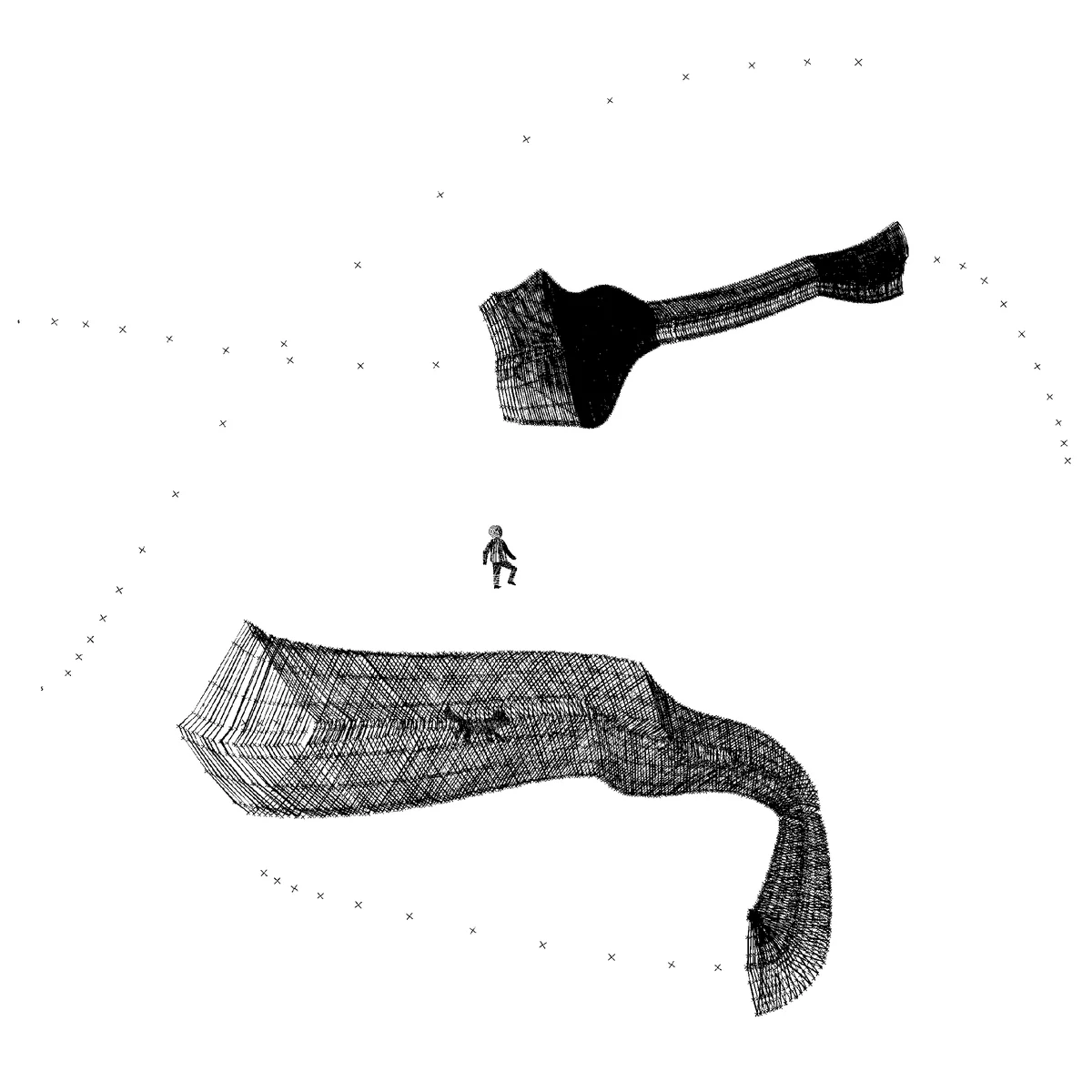
“Everything is tubular, hollow, covered, wrapped. And perhaps we are passing through it, or already have.” A drawing tool qubibi is still nurturing. Works made with it are released on several platforms, and all of them are shown at throughtubes.qubibi.org. Sales list. See more images.
hello world at Galerie Met, Berlin
Held November 1 to 15, 2025, with the opening on October 31. A solo exhibition at the invitation of Galerie Met, in collaboration with objkt. Curated by Kika Nicolela. The show had three parts: Echoes, a series of stills; Rooms, four videos; and hello world itself, generating in real time in a small room. Exhibition page. Exhibition text by Galerie Met (PDF). Read the conversation with Kika Nicolela. See more images.
hello world
hello world is qubibi's first generative work. Since its release in 2010 it has been adjusted continuously, producing several derivative works along the way. The version shown at Galerie Met, Berlin, is the latest. Private sale. Inquiries here Sold out. See more images.
hello world: Echoes
Ninety still images of hello world, as prints and digital works, shown at the solo exhibition at Galerie Met, Berlin. Released on objkt. Collect here Sold out. The fifty prints are listed here.
hello world: Rooms
Four videos of about ten minutes each, cut from recordings of hello world and made for the solo exhibition at Galerie Met, Berlin. Released on objkt. Collect here Sold out. See more images.
MIMIZU BOOK on Sale in Japan at SunM Color
Since December 2025, five of the ninety copies have been on sale at the SunM Color store, run by the book's printer. The book was launched in December 2024 at Nguyen Wahed, New York.
A Snap in Time
“It might be the rhythm that marks time and moves the heart. It might be magic that shifts time and shifts space.” An interactive work that snaps its fingers when touched. Turn the sound on. Released on Verse on August 6, 2025. Collect here Sold out. See more images.
Sketching leftover
A work that keeps drawing lines, with sound, from m2111081303, an early release in the leftover series. An edition of thirty. Turn the sound on. Released on objkt on July 14, 2025. See more images.
Water Studies
Thirty generative works. In Japanese the title is 水図, pronounced MIZU-ZU; any resemblance to MIMIZU is coincidental. Released on Verse on December 16, 2025. Collect here Sold out. See more images.
Yesterday
A long-form generative work in on-chain SVG, and a second one that develops its shapes and colors. Open them at yesterday.qubibi.org. Released on bootloader in September 2025. Collect here Sold out: 333 pieces and 365 pieces.
IM MEN: ISSEY MIYAKE Spring Summer 2026 “DANCING TEXTURE”
The collection's theme is the ceramicist Shoji Kamoda. Commissioned by ISSEY MIYAKE INC. qubibi made new artwork for the printed matter and the video screened at the exhibition. Music for the video by Matthew Herbert. The collection was presented at Paris Men's Fashion Week in June 2025. Watch the video. See more images.
Interview in Bijutsu Techo, a Japanese Art Magazine
February 21, 2025. Interview by Hiroyasu Yamauchi, photography by Kohei Kanno. I thought I had said a lot; reading the result, it seems I said nothing at all.
Awakened
A long-form interactive work. Its full title is “Awakened - Close the eye and shout quietly.” Shown at the group exhibition Tamagotchi in New York, curated by the gallery Nguyen Wahed, on October 26 and 27, 2024, then released as an open edition on Highlight from November 18 to December 2, 2024, closing at 315. Turn the sound on. Awakened on Highlight. Try the demo version. Collect here Edition closed. See more images.
MIMIZU BOOK
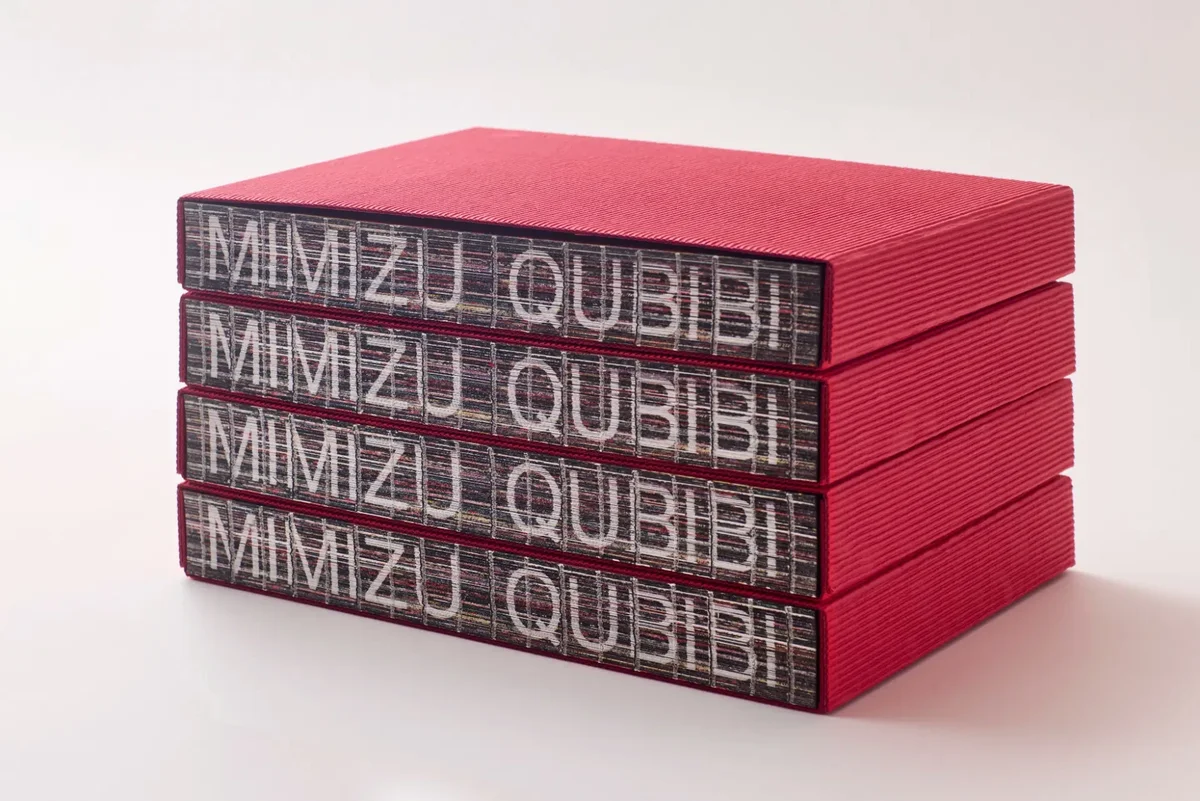
An art book released as the complete collection of MIMIZU. Ninety hand-bound copies plus five APs, 25 × 34.5 cm, 600 pages in full color, 384 works, four cover variations. Essays by Mimi Nguyen and Casey Reas. Presented at Last Tango, Nguyen Wahed, New York. Every copy is signed and numbered. The edges are painted by hand, one sheet at a time, with pesticide-free ink made in Japan, which comes off on the fingers that turn the pages; the worm-like sleeve dents the more it is held. Enjoy how it ages. Paper: cover Color Plan-FS Black 217 kg, text b7 Bulky 69 kg. Designed by Takuma Hayashi, printed by SunM Color. Available from Nguyen Wahed, or in Japan from the SunM Color store. See more images.
Interview in Le Random, a Generative Art Institution
Held December 15, 2024, to January 31, 2025. Curated by Mimi Nguyen. A solo exhibition, timed with the release of the art book MIMIZU. To acquire a work, contact the gallery. Released on Highlight. Collect here Sold out. Exhibition page. See more images.
ERRR: Fakewhale Solo Series on objkt
Presented by Fakewhale on October 16, 2024: three new works, ERRR 11, ERRR 12 and ERRR 13. The ERRR works are failed renders of mimizu. Fakewhale on ERRR. Collect here Sold out.
MATTER & DATA by objkt at the Digital Art Mile, Basel
Held June 10 to 16, 2024, at Space31. A group show alongside Art Basel. qubibi showed mimizu ERRR 9 and ERRR 10. ERRR 10 illustrated The Art Newspaper's report on the Digital Art Mile, online and in print. Read the article. mimizu ERRR on objkt. Press release (PDF).
Featured in On NFTs, a TASCHEN Book
A survey of NFT art through 101 artists, qubibi among them. It launched at the TASCHEN store in Paris on February 22, 2024. The book shows three pieces of mimizu, with a commentary and an essay by Mimi Nguyen. A piece of mimizu is also the background of the table of contents. On NFTs at TASCHEN. See more images.
MIMIZU for IBM One Madison Avenue
Two new pieces of mimizu. They hang in IBM's flagship office in New York. Commissioned by IBM, made with Artist Uprising. See more images.
Dimensionality by TENDER at Untitled Art, Miami Beach
Held December 5 to 10, 2023, at Untitled Art, one of the major fairs held alongside Art Basel Miami Beach. A group show of eight artists, organized by TENDER. qubibi made fifty-five new pieces of mimizu Untitled for this show. mimizu Untitled on Verse. Collect here Sold out. See more images.
SOURCE on Feral File
Opened September 19, 2023. Curated by Operator (Ania Catherine and Dejha Ti), 0xDEAFBEEF and Casey Reas. An online group exhibition. qubibi showed a piece of mimizu. Instead of joining the exhibition's talk, qubibi wrote a letter for the Feral File journal. Read the letter.
TECHNO TERRAIN at Expanded.Art, Berlin
Held August 29 to September 9, 2023. Curated by Anika Meier. A group show in collaboration with objkt.one. A new piece of mimizu, which qubibi calls Mimizu Tree, was shown. Hans Dehlinger made a white wooden frame by hand for this work, and it hung beside a tree piece by Dehlinger himself. Read the interview by Anika Meier. Exhibition page. Collect here Sold out. See more images.
Featured in Gorilla Sun, a Generative Art Blog
August 24, 2023. The essay “Style, Voice and Identity in Generative Art” by Ahmad Moussa gives one of its three chapters to qubibi. It traces qubibi's path from hello world through the solo show at the Museum of Digital Art (MuDA), Zurich, to mimizu and wiwizn. Read the article.
NFT Show Europe at the City of Arts and Sciences, Valencia
Held July 14 and 15, 2023. qubibi showed five pieces of mimizu. Collect here Sold out.
mimizu in VAULT, Fakewhale's Permanent Collection
A piece of mimizu made at Fakewhale's request for VAULT, its permanent online collection. It entered the collection on May 23, 2023. On May 29, Fakewhale's FW LOG ran a profile of qubibi. qubibi on Fakewhale. Read the FW LOG article. See more images.
QUBIBI SOLO SHOW PART I & II at Galerie Data, Paris
Held April 26 to June 17, 2023. Curated by Gabrielle Debeuret, the director of the gallery. A solo exhibition in two parts, each with its own opening: Part I from April 26 to May 20, and Part II from May 24 to June 17. Fifteen works from mimizu and wiwizn, two series grown from the algorithm that began with hello world. Released on objkt. Collect here Sold out. Press release (PDF). See more images.
Margaret
“Smile, Margaret, smile, smile.” A long-form work of one hundred still images. Minted on site at The Tokyo Collection by Bright Moments (the former Asakura residence, Tokyo, May 2023). Collect here Sold out. See more images.
The Tokyo Collection by Bright Moments at the former Asakura residence, Tokyo
Held as Bright Moments Tokyo, May 5 to 12, 2023. A group show where the works were minted on site. qubibi showed Margaret. Bright Moments Tokyo. Interview by Bright Moments. See more images.
Panel Talk on Generative Art at Bright Moments Tokyo
Held May 9, 2023, at the Shibuya PARCO DG Building, Tokyo. With Takawo and 0xhaiku on the panel, qubibi talked about the work Margaret.
Featured in ARTouch, a Taiwanese Art Magazine
March 13, 2023. A profile of qubibi, reprinted from c2x3 on Matters. It follows qubibi from the AUDIO ARCHITECTURE exhibition at Huashan1914 Creative Park, Taipei, in 2020, to the present. Read the article (Chinese).
objkt.one x Fakewhale at Art Dubai
Art Dubai Digital Art Pavilion, March 1 to 5, 2023. Curated by Fakewhale and objkt. A new mimizu work was released for the launch of objkt.one. Exhibition page on objkt. Art Dubai. Collect here Sold out. See more images.
wiwizn Part III at Cromwell Place, London
Held January 26 to 29, 2023. A solo exhibition devoted to wiwizn, organized by Verse. Ten works closed the series of twenty-five. The night before the opening, Verse hosted a private dinner at the venue for the collectors of the series. Exhibition page on Verse. See more images.
wiwizn Part III on Verse
Ten of the series' twenty-five works were released as the last of the three parts, and shown at Cromwell Place in London, January 26 to 29, 2023. See the works on Verse. Collect here Sold out. See more images.
Interview in Right Click Save, a Digital Art Magazine
January 2023. It covers where the name qubibi comes from, and generation as something that arrives rather than something intended. Read the interview.
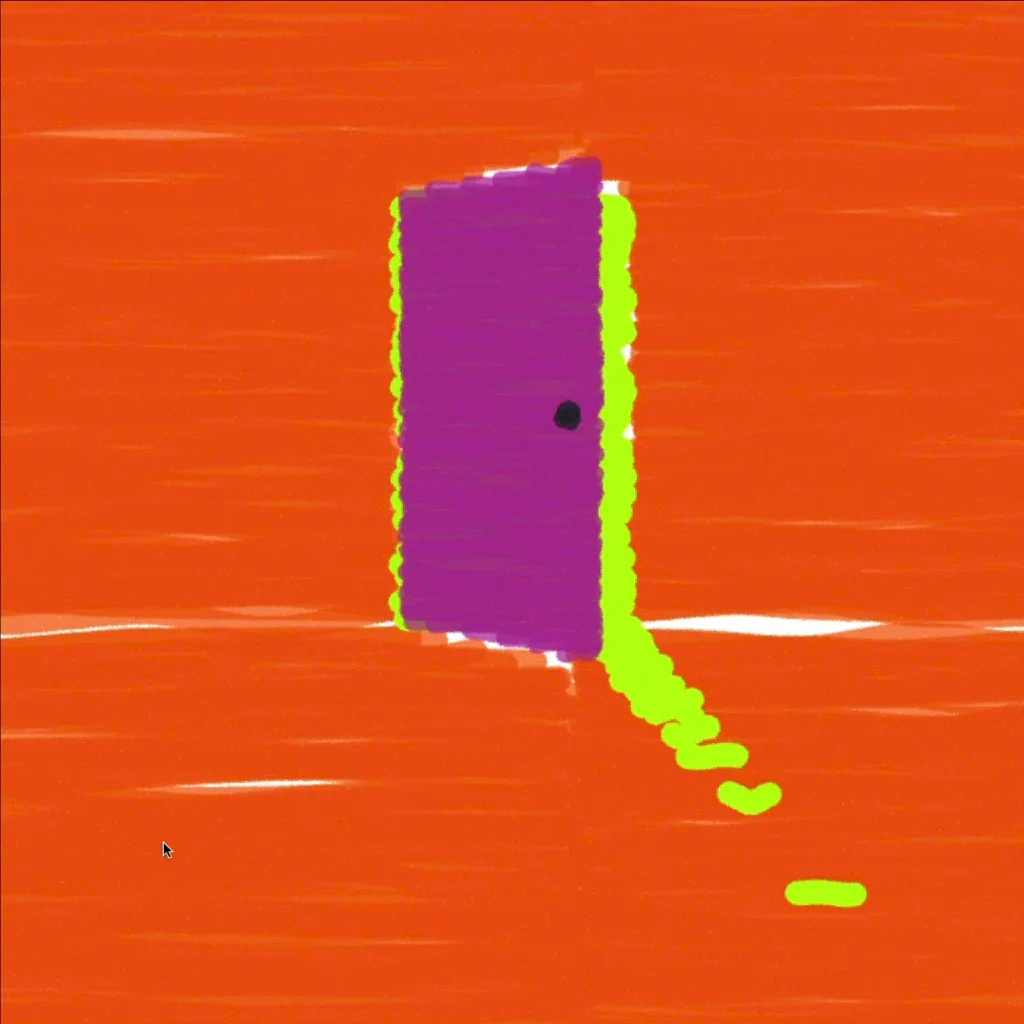
“Magical” Door
“Open and close the door.” Music by Schumann (Der Nussbaum), vocals by Mysz-Gmeiner, from a Grammophon recording of around 1928. A long-form interactive work, first shown at Magical Realism, a group show by Verse (Cromwell Place, London, December 2022), and released on Verse as an open edition that closed at 804. Turn the sound on. “Magical” Door on Verse. Try the demo version. Collect here Edition closed. See more images.
Magical Realism at Cromwell Place, London
Held December 14 to 18, 2022. A group show organized by Verse, taking Haruki Murakami's fiction as its starting point. qubibi showed the interactive work “Magical” Door. Exhibition page on Verse. “Magical” Door on Verse. See more images.
storeroom
A series of the pieces left on hand after mimizu stopped at number 222. The name comes from the thought that works would be put away in a storeroom. Released as NFTs and prints from 2022 to 2024, on objkt, Verse and Manifold (on OpenSea). Collect here Sold out.
Interview in GatherArt, a Tezos Art Website
November 18, 2022.
wiwizn Part II on Verse
Ten of the series' twenty-five works were released October 24 to 31, 2022. See the works on Verse. Collect here Sold out. See more images.
Interview in Kaloh's Newsletter, a Substack on Onchain Culture
Held July 15 to 20, 2022. An online exhibition curated by Jason Bailey of Artnome. Five of the series' twenty-five works were shown. Alongside the show, Verse published a three-way conversation between qubibi, Bailey and Mimi Nguyen. Exhibition page on Verse. Read the conversation. Collect here Sold out. See more images.
WIWIZN
The name WIWIZN comes from the shape of the shadow that rises from the foot of the letters MIMIZU when light falls on them. Where MIMIZU draws light in the dark, WIWIZN draws shadow on light. Twenty-five works in all, presented in three parts with Verse from July 2022, closing with Part III at Cromwell Place, London, in January 2023. Collect here Sold out. See more images.
Proof of People at fabric, London
Held July 6 to 8, 2022. An NFT festival for art and culture, organized by Vertical Crypto Art. A piece of mimizu was projected.
Featured in THE NEW CREATOR ECONOMY, a BNN Book
A book on NFT art, released on November 16, 2022. qubibi's mimizu appears in Part 4, Generative Art. Publisher page (Japanese).
POSITIONS Berlin Art Fair at the former Tempelhof Airport
Held September 15 to 18, 2022. qubibi showed a few pieces of mimizu.
COLOR[FRAME] at Plateforme, Paris
Held May 20 to June 5, 2022. A group show on color in generative art. Curated by Galerie Data. qubibi showed works from mimizu.
A corporate website made for FANTASIA inc., a project space in Fukuoka. Launched in 2022. Art direction, design and programming by qubibi. See more images.
leftover
A series releasing what came out of making mimizu but did not become works: leftovers, so to speak, like what is left on the plate. Its note reads: “Leftovers of mimizu. Or someone else's leftovers.” Started as NFTs on hic et nunc in 2021. leftover on objkt. See more images.
MIMIZU
A generative series of still images, woven from dense lines. The algorithm born in hello world gave rise to ONGAKU MIMIZU, a video work of 2018, and MIMIZU is ONGAKU MIMIZU made as still images. Following Jonas Mekas, who sold single frames of his films as photographs, qubibi put them out one by one as a worm shop. It began on hic et nunc in 2021, and went on to storeroom, mimizu Untitled on Verse, and Last Tango on Highlight. In December 2024, the art book MIMIZU, the culmination of the series, was released at Nguyen Wahed in New York. Commissions available upon request. mimizu on objkt. See more images.
If You Look Up
Wherever they are, the viewer stands with qubibi at their back, facing the Museum of Digital Art (MuDA), Zurich, where qubibi held a solo exhibition in 2017. See more images.
Worm Fabric at Nadoya Ebisu, Tokyo
A solo exhibition held September 10 to October 3, 2021, in a sixty-year-old house in Tokyo. qubibi's works from the past to the present filled the whole building; upstairs, hello world played with music by Masahiko Satoh. WORM FABRIC, a fifty-meter length of fabric, hung from the ceiling. During the show, qubibi, who once worked at a fabric-cutting factory, cut it by length and sold it. Sold out. Event listing on Tokyo Art Beat. Text by Nadoya Ebisu. See the pamphlet. See more images.
Mitippo Selected for the Digital Ehon Award 2020
A children's app from 2019, among the selected works of the eighth edition. Art direction and programming by qubibi, entered by DIGICORO.
AUDIO ARCHITECTURE at Huashan1914 Creative Park, Taipei
Held December 25, 2020, to April 6, 2021, in Taipei. A touring exhibition from 21_21 DESIGN SIGHT, Tokyo. qubibi showed ONGAKU MIMIZU.
Concert at Jofukuji, Sagamihara
A performance by the pianist Masahiko Satoh and qubibi, who generated the visuals in real time. October 10, 2020, at Jofukuji, a temple of the Rinzai Kenchoji school in Sagamihara, Kanagawa. See more images.
YP Report 2021 Artwork
Artwork for YP Report 2021, the annual report of the tax accounting firm Yamada & Partners. Commissioned by Yamada & Partners, made with ADK Marketing Solutions and PAGE.
Border Play
A video installation for the Motion Corridor at Pia Arena MM, Yokohama. Eight works drawn by a single rule of moving borders between colors. Shown from July 1, 2020, to 2022. Commissioned by PIA Corporation, made with Bascule. Art direction and programming by qubibi. Sound production by Koshi Miura of □□□. Text by qubibi. See more images.
Mitippo
A children's app about roads, made for DIGICORO, a toy you roll across an iPad. Launched on the App Store in 2020. Commissioned by B2ENGINE. Art direction, design and programming by qubibi. Selected for the eighth Digital Ehon Award (2020). Selected works of the award (Japanese). See more images.
Artwork for nowJapan, a Japanese Culture Festival in Vilnius
The festival ran from September 10 to 15, 2019. Used on its posters and guide. Commissioned by nowJapan. Artwork by qubibi. nowjapan.lt. See more images.
Mikuni House Artwork
Artwork for fusuma sliding doors, made for the renovation of a house in Mikuni, Fukui. Made in 2019. Artwork by qubibi. See more images.
Concert at Jofukuji, Sagamihara
Seito kara Itan e, Sei kara Zoku e (From Orthodoxy to Heresy, from the Sacred to the Profane) was a fully improvised performance by Tomoki Tai on cello, Sachiko Nagata on the hamon (an iron percussion instrument) and qubibi, who generated the visuals in real time. October 27, 2018, at Jofukuji, a temple of the Rinzai Kenchoji school in Sagamihara, Kanagawa.
Pink Soup Party at SuperDeluxe, Tokyo
A live performance with the musician Daisuke Tanabe: Tanabe on music, qubibi on visuals generated in real time. October 25, 2018, at SuperDeluxe, Tokyo, as part of Pink Soup Party, a yearly evening of Lithuanian music and food.
AUDIO ARCHITECTURE Relay Talk at 21_21 DESIGN SIGHT, Tokyo
Held September 15, 2018. The third in a series of talks by artists in the exhibition. The speakers were Keita Onishi, Ryo Orikasa and qubibi. qubibi's talk was on the making of ONGAKU MIMIZU. Page at 21_21 DESIGN SIGHT (Japanese).
AUDIO ARCHITECTURE Talk on DOMMUNE
Broadcast live from Shibuya, Tokyo, on July 11, 2018, for the exhibition AUDIO ARCHITECTURE at 21_21 DESIGN SIGHT. The speakers were the exhibition director Yugo Nakamura, Keigo Oyamada (Cornelius) and the participating artists, qubibi among them. Hosted by Naohiro Ukawa. Page on DOMMUNE (Japanese).
AUDIO ARCHITECTURE at 21_21 DESIGN SIGHT, Tokyo
Held June 29 to October 14, 2018, in Tokyo. A group exhibition directed by Yugo Nakamura. Keigo Oyamada (Cornelius) composed a new song for the exhibition. Nine creators each made a video work based on it. qubibi showed ONGAKU MIMIZU. Exhibition page. See the pamphlet.
オンガクミミズ / ONGAKU MIMIZU
Music, drawn as a pulsing sequence of cross sections. A generative video work commissioned by 21_21 DESIGN SIGHT for its exhibition AUDIO ARCHITECTURE (21_21 DESIGN SIGHT, Tokyo, 2018). Text by Dominique Chen. Video on YouTube. See more images.
混沌の王国 (KONTON NO OUKOKU)
A video installation inspired by the workings of the immune system. Made for the exhibition Meiji-Do Wonders #01 (SO-CAL LINK GALLERY, Tokyo, February 24–25, 2018). Commissioned by Meiji Co., Ltd. Art direction and programming by qubibi. Statement. Article on SPICE (Japanese). See more images.
A farewell event for DESIGN Koishikawa, Tokyo, hosted by crewimburnny. Daisuke Tanabe's sound and qubibi's visuals, performed live together. Held June 30, 2018.
hello world Selected for Japan Media Arts Festival
The video work hello world was named a Jury Selection in the Art Division of the twenty-first Japan Media Arts Festival in 2018, its second.
Reviewed in Bijutsu Techo, a Japanese Art Magazine
The January 2018 issue carried a review of Qubibi Exhibition at the Museum of Digital Art (MuDA), Zurich.
KrewinburNny at DESIGN Koishikawa, Tokyo
A dance performance by crewimburnny, directed and choreographed by Nagisa Sugao, with visual direction by qubibi. Staged from November 30 to December 3, 2017, at DESIGN Koishikawa, Tokyo. See the flyer. See more images.
MUNDA
The man just keeps washing his body, scrubbing the dirt away. An interactive work made for qubibi's solo exhibition (MuDA, Zurich, 2017). Text by MuDA. See more images.
Game for Life
An unplayable game built into a modified cathode-ray tube monitor. The last work finished for qubibi's solo exhibition (MuDA, Zurich, 2017). Text by MuDA. See more images.
Diagolus
An installation in which visitors operate a purpose-built, mouth-shaped device, making a man and a woman on screen speak in words no one can quite make out. Two visitors who have never met still get the feel of a conversation. The title is a coined word joining “dialogue” with the dinosaurs of deep time. Made for qubibi's solo exhibition (MuDA, Zurich, 2017). Text by MuDA. See more images.
stop the hello world
Put in one franc, and hello world, always in motion, comes out on paper as it was at that moment. An installation made for qubibi's solo exhibition (MuDA, Zurich, 2017). See more images.
hello world at MuDA, Zurich
hello world as it stood in 2017, seven years after its release. It ran in the gallery throughout qubibi's solo exhibition (MuDA, Zurich, 2017), generating its animation in real time at 26 frames per second. In the same exhibition, stop the hello world printed a single moment of it on paper. Text by MuDA. See more images.
Qubibi Exhibition at MuDA, Zurich
qubibi's first solo exhibition outside Japan. Held September 9, 2017, to January 28, 2018, at the Museum of Digital Art (MuDA), Zurich. Nine works were shown: hello world, KOKUHAKU, MUNDA, INDIA, Game for Life, KANNON, stop the hello world, Swimmer and Diagolus. Text by MuDA. See the pamphlet. See more images.
KOKUHAKU
The video for the ASA-CHANG & JUNRAY song “Kokuhaku,” remade as a vertical work. Made for qubibi's solo exhibition (MuDA, Zurich, 2017). Text by MuDA. See more images.
Sketches of Mundare
A video work made for the large screens of Shinjuku, shown during Shinjuku Creators Festa (Tokyo, September 24 to October 10, 2016). See more images.
Kanemasu Image Exhibition, Shibata
A solo exhibition at the invitation of the Kanemasu sake brewery. Held in 2016 at its No. 2 Gallery, Shibata, Niigata. qubibi showed hello world as a projection. Projection coordination by Tomoya Kishimoto. See more images.
ASA-CHANG & JUNRAY「告白」 (KOKUHAKU) MV
The 2016 music video for “Kokuhaku” (Confession) by ASA-CHANG & JUNRAY. The lyrics are qubibi's own profile text, which moved ASA-CHANG so much that he used it almost word for word. A website of endlessly generated animation was released alongside the video. Commissioned by P-Vine Records and ASA-CHANG & JUNRAY. Art direction and programming by qubibi. Watch on YouTube. See more images.
ASA-CHANG & JUNRAY「まほう」 (MAHOU) Artwork
The album was released on March 2, 2016. Commissioned by P-Vine Records and ASA-CHANG & JUNRAY. Artwork by qubibi. See more images.
GLACIER FORMATION
An installation made for AGC Inc.'s exhibition at Milan Design Week. Shown at Superstudio Più, Milan, from April 14 to 19, 2015. Commissioned by ADK Arts. Visual design by qubibi. Art and technical direction by LUFTZUG. See more images.
Maywa Corporate Website
Maywa is a packaging company in Nagoya. The site launched in 2014. Commissioned by Maywa. Art direction, design, programming and photography by qubibi. See more images.
巨人モンタージュ (Titan Montage)
A special website for the Attack on Titan Exhibition. Launched on November 14, 2014. Commissioned by the Attack on Titan Production Committee, made with Dentsu and KAIBUTSU. Art direction, programming and music by qubibi. Watch on YouTube. See more images.
Aufheben! Vol.2 at Aoyama CAY, Tokyo
The second night of Aufheben!, a live series by ASA-CHANG & JUNRAY, this time exploring music and image. The series takes its name from Hegel's Aufheben: the old is overcome, and its best is carried into something new. December 6, 2014, at CAY, Aoyama, Tokyo.
Mikoshiman
An interactive banner made for Yorupane! on Yahoo! JAPAN. Launched in 2014. Commissioned by Yahoo! JAPAN. Design and programming by qubibi.
Concert at Jofukuji, Sagamihara
Ariake no Tsuki, Sagari Zuki (The Moon at Dawn, the Sinking Moon) was a fully improvised performance by the pianist Masahiko Satoh and qubibi, who generated the visuals in real time. September 28, 2013, at Jofukuji, a temple of the Rinzai Kenchoji school in Sagamihara, Kanagawa.
Bascule's HAJIHAJI Interactive CM
An interactive commercial for Bascule's new venture, Massive Interactive Entertainment. Launched on June 11, 2013. Commissioned by Bascule. Art direction and programming by qubibi.
Adobe Creative Cloud Web Section Artwork
Artwork representing the web category of Adobe Creative Cloud. Made for the launch of the first CC versions of its apps in June 2013. Commissioned by Adobe Systems. Art by qubibi.
DRIFTER
Interactive special content inside NURO DEVILMAN, the campaign site for So-net's NURO fiber internet service. Launched on December 13, 2013. Commissioned by So-net Corporation, made with Dentsu and KAIBUTSU. Direction, art direction and programming by qubibi. Vocals on “Drifter Theme” by the novelist Kageki Shimoda. See more images.
Fill Spector for iOS
An iOS game starring the character Fill Spector. Released on April 16, 2013. It is no longer on the App Store. Commissioned by WOW inc. Game design, art direction, design and programming by qubibi. See more images.
Concert at Koen-dori Classics, Tokyo
A fully improvised performance by the pianist Masahiko Satoh and qubibi, who generated the visuals in real time. July 28, 2012, at Koen-dori Classics, Tokyo. Projection coordination by Tomoya Kishimoto.
hello world Exhibition at FRAMED* SPACE, Tokyo
Held April 17 to May 11, 2012, in Tokyo. The first of the FRAMED* EXHIBITION series, which shows works on FRAMED*, tha ltd.'s digital art frame for the home. Four works were shown: hello world “Texture”, “Journey Through Inner Self” and “LIZARDMAN”, and KANNON. Text by Yugo Nakamura. See the flyer.
KANNON
An interactive work that turns the sound of the room into shapes. The title comes from the bodhisattva Kannon, whose name is written with the characters for “see” and “sound.” First shown at the hello world Exhibition (FRAMED* SPACE, Tokyo, 2012). Revised for qubibi's solo exhibition (MuDA, Zurich, 2017). Text by MuDA. See more images.
hello world for FRAMED
Three generative works made for FRAMED*: hello world “Texture”, “Journey Through Inner Self” and “LIZARDMAN”. FRAMED* is tha ltd.'s digital art frame for the home. The three were released in 2012, each in an edition of one hundred. Shown at the hello world Exhibition (FRAMED* SPACE, Tokyo, 2012). See more images.
Fill Spector
An original character and its official website. The website launched in 2012. Commissioned by WOW inc. Planning, character design, art direction, and graphic and website design by qubibi. See more images.
Today's Smile
Every day, it showed which way the wind was blowing from Fukushima. Made in response to the Great East Japan Earthquake of March 2011 and the nuclear accident that followed, a net art work launched the same year. It was shown as a Jury Selection at the Japan Media Arts Festival (National Art Center, Tokyo, 2012). See more images.
WANWANLINK
Out of a vast amount of public-domain footage, clips are spliced so that a movement in one carries over into the next. A net art work launched in 2011. Sound design and programming by qubibi. See more images.
adidas skin protection SHOOTTER
An interactive website for the adidas skin protection line. Launched in 2011. Commissioned by KOSE, made with Hakuhodo and mount. Art direction, direction, planning and programming by qubibi.
Is Anyone There?
An installation made as one of the VisuaMusio works, shown at the Centre Pompidou, Paris, during Tokyo Graphic Passport, September 22 to October 3, 2011. Commissioned by WOW inc. Art direction and programming by qubibi. See more images.
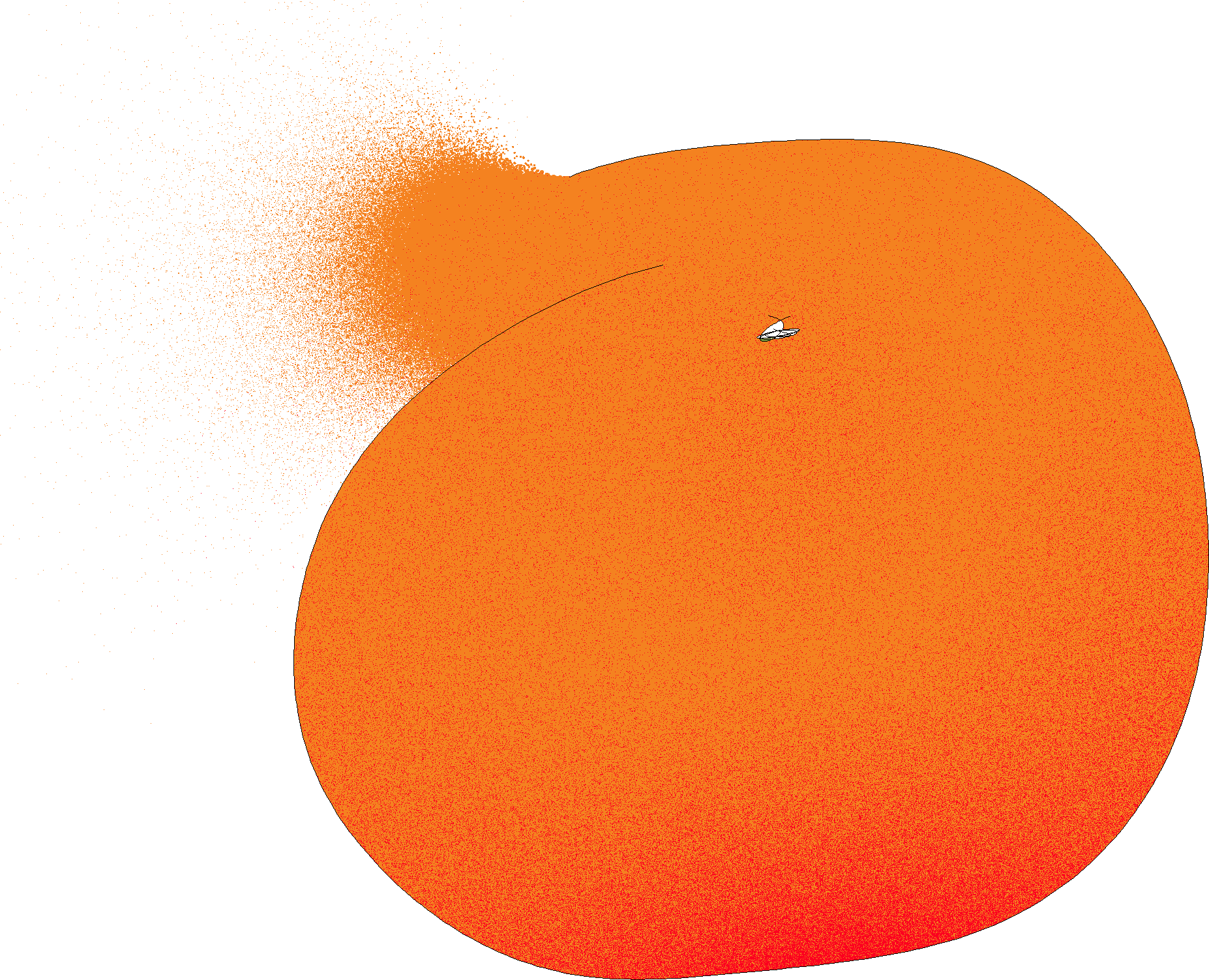
hello world
Code draws an animation in real time, without end. qubibi's first and last generative work, released in 2010 on SCR, the pioneering digital art label by tha ltd. Since then it has been shown in many forms and adjusted again and again. Text by qubibi. See more images.
YEAR OF THE TIGAAA
A work for the year of the tiger. An application released in 2010 on SCR, the pioneering digital art label by tha ltd. See more images.
Left Eye, Right Eye “Salyu”
A video installation with the singer Salyu as guest model, first shown in October 2010 at the art festival 404 Not Fashion (TABLOID, Tokyo). Commissioned by ANSWR. Art direction and programming by qubibi.
Yugo Preview
Interactive content made for a talk event between the designer Yugo Nakamura and qubibi. Launched in 2009. Commissioned by ANSWR. Art direction, programming and sound by qubibi. See more images.
Swimmer
Dozens of swimmers, each filmed while actually dozing off, speak of their own dreams. The title plays on "suima", Japanese for drowsiness. A screensaver work released in 2009 on SCR, the pioneering digital art label by tha ltd., and shown in qubibi's solo exhibition (MuDA, Zurich, 2017). Text by MuDA. Watch on YouTube. See more images.
ENJIN Corporate Website
ENJIN is a creative agency in Tokyo. The site launched in 2009. Commissioned by ENJIN, made with Aoyama Creative Studio. Art direction, design and programming by qubibi. See more images.
BorneLund Corporate Website
BorneLund is a Japanese company that deals in children's toys and play equipment. Its corporate website and shopping site (bornelund.co.jp) launched in 2009. Commissioned by BorneLund, made with Aoyama Creative Studio. Art direction and design by qubibi.
adidas SALA FESTA 2009
A campaign website. Launched in 2009. Commissioned by adidas Japan K.K., made with ENJIN. Art direction and programming by qubibi.
AXE COLLECTION
A campaign website for a line of men's fragrances. Launched in 2008. Commissioned by Unilever Japan K.K., made with Bascule. Art direction by qubibi.
TORIKAGO
Interactive special content for a Microsoft Japan campaign site. Launched in 2007. Commissioned by Microsoft Japan, made with Bascule. Art direction, design, programming and photography by qubibi. See more images.
INDIA
An interactive website for the magazine Pen. Launched in 2007. Commissioned by Hankyu Communications, made with TYOID. Art direction and programming by qubibi. Later shown at Tinypalace, the alternative games festival in Kassel (2016), and at qubibi's solo exhibition (MuDA, Zurich, 2017). Text by MuDA. Watch on YouTube. See more images.
DAYDREAM
An interactive website for the Weave Toshi 2006 collection. Commissioned by Weave Toshi. The third of the Weave Toshi collection sites, following defy,defy,defy, and Possibility. Its awards include a Silver at Cannes Lions, D&AD and The One Show. Art direction, design, programming and photography by qubibi. Watch on YouTube. See more images.
Possibility
An interactive website for the Weave Toshi 2005 collection. Commissioned by Weave Toshi, the hat company behind CA4LA. The second of the Weave Toshi collection sites, following defy,defy,defy,. Art direction, design, programming and photography by Kazumasa Teshigawara.
defy,defy,defy,
An interactive website for the Weave Toshi 2004 collection. Commissioned by Weave Toshi, the hat company behind CA4LA. The first of the Weave Toshi collection sites. Art direction, design, programming and photography by Kazumasa Teshigawara.
Weave Toshi Corporate Website
Commissioned by Weave Toshi, 2004 to 2006. Weave Toshi is the hat company behind CA4LA. Art direction, design, programming and photography by Kazumasa Teshigawara.
Roppongi Hills Arena Official Website
The arena is an event space at Roppongi Hills. The site was online from 2003 to 2006. Commissioned by Mori Building. Art direction, design and programming by Kazumasa Teshigawara.
LAFORET HARAJUKU Official Site
Commissioned by Laforet Harajuku, 1999 to 2006. Art direction, design and coding by Kazumasa Teshigawara.
qubibi
A project by Kazumasa Teshigawara.
Interactive and generative art since 2006, Tokyo.
Kazumasa Teshigawara. Born in Ikebukuro, Tokyo, 1977. Used to live with mother in the beginning. Later moved in with a new family. Was taken around bars while still young. Hostesses used to like me a lot. I stopped going to school. Played game at home. Cried and called the police on the yakuza. Father ran away, got caught. Graduated elementary school. Got into an accident and hurt my neck. Father came back. Father died. Graduated junior high. Worked at a textile processing factory in Nihonbashi. Got into an accident, almost died, and hurt my neck. Got into music. Quit stippling. Bought a Mac. Met some weird people. Said goodbye. Unknowingly entered a shady agency and quit immediately. Got threatened. Was scared for days. Worked and quit a number of jobs. At age 21, discovered the fun of design. Eventually got married. Had a kid. Got divorced. Got the kid. Started qubibi. Taking care of the kid. Would like to make a lot of things.